




A complex similar to the NF-Y transcription factor is essential for oocyst rupture
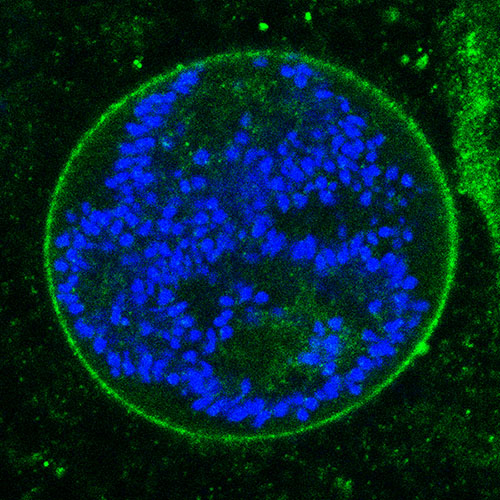 |
| Oocyst with sporozoites being formed (DNA, blue) and ORP protein in the periphery (green) |
Parasites enter the mosquito via an infected blood meal. Within minutes the sexual stages (gametes) have developed and fertilization takes place leading to the formation of a motile form of the zygote called the ookinete. It traverses the midgut epithelium and forms the sporogonic oocyst on the haemocoel side of the midgut. During the next ~10 days sporozoites develop in a syncytium inside the oocyst, which is delimited by the oocyst capsule. When mature sporozoites have formed, the oocyst ruptures and releases the sporozoites which next transfer to the salivary gland. They will then be injected into the skin of the mammalian host when the mosquito takes another bite. Our research has discovered a novel protein complex essential for the rupture of the oocyst. This complex has similarities to the DNA binding transcription factor NF-Y in higher eukaryotes, but the proteins of the complex, that we call ORPs (Oocyst Rupture Proteins), are located at the periphery of the oocyst, likely constituents of the oocyst capsule, a little-known protective structure surrounding the oocyst. Deletion of each of the genes encoding the ORP proteins leads to a block in the rupture of the oocyst; consequently, the sporozoites are not released, and thus transmission through the mosquito is blocked. Their essential role in mosquito transmission of the parasite has motivated identification of inhibitors blocking the formation of the complex, which could putatively be used for transmission-blocking strategies.
This research is carried out in collaboration with Chiara Curra, Istituto Superiore di Sanità, Rome.
References:
Currà et al. (2016) Release of Plasmodium sporozoites requires proteins with histone-fold dimerization domains. Nat Commun. 2016 Dec 16;7:13846. doi:
Siden-Kiamos et al. (2018) Identification of Plasmodium berghei Oocyst Rupture Protein 2 (ORP2) domains involved in sporozoite egress from the oocyst. Int J Parasitol, Nov 1. pii: S0020-7519(18)30247-9. doi: 10.1016/j.ijpara.2018.09.004
Siden-Kiamos et al. (2020) A method for purification of Plasmodium oocysts from mosquito midguts. Sci Rep. 2020 Apr 29;10(1):7262. doi: 10.1038/s41598-020-64121-1.
Preira et al (2024) A time point proteomic analysis reveals protein dynamics of Plasmodium oocysts. Mol Cell Proteomics, 2024 Feb 9:100736.doi: 10.1016/j.mcpro.2024.100736.
Ballabio et al. (2025) Targeting the Histone-fold dimerization interface of Oocyst Rupture proteins from Plasmodium berghei for anti-Malarial inhibitor discovery. FEBS Journal FEBS70389 DOI: 10.1111/febs.70389