




I. Siden-Kiamos Laboratory
Interaction of the olive fly with its symbiont
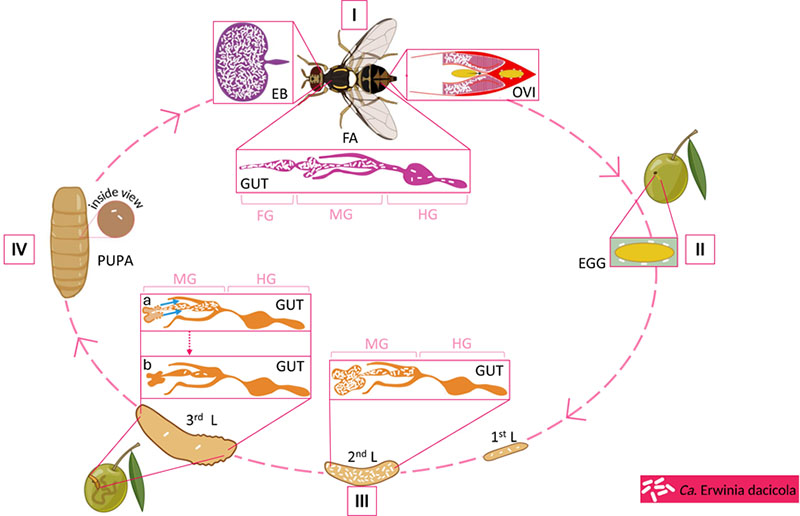 |
| Life cycle of the fly highlighting the organs that harbor the bacteria |
The olive fly Bactrocera oleae is the most serious threat to olive farming and causes huge losses in income from this important crop. The fly is dependent on the symbiotic bacterium Candidatus Erwinia dacicola for the completion of the life cycle in the olive mesocarp. The female fly lays the egg in the olive, and the resulting larvae tunnels through the fruit using the flesh as the source for nutrition. In the green unripe olive, the larvae depend on the bacterium for survival, but the reason for this is not yet clear, but could be due to the bacterium producing factors aiding in detoxification of the phenolic compounds in the olive and/or providing nutrients to the larvae. Furthermore, in the adult stage the symbiont contributes to the nutrition of the fly which mainly use nitrogen-poor food sources. Our research, in collaboration with the laboratory of John Vontas, aims to understand the interaction of the host with the symbiont in order to explore novel strategies to control the fly.
The malaria parasite in the mosquito
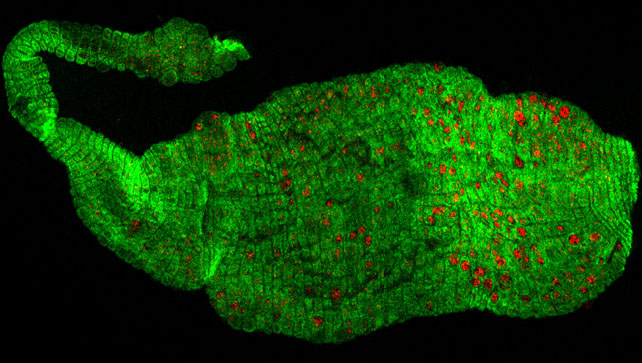 |
| Ooocysts (red) on mosquito midgut (green) |
Research on malaria parasites is primarily motivated that malaria remains a devastating disease leading to 250-400 million infections and approximately half a million deaths every year. Together with economic loss associated with the disease, these figures contribute to a dramatic developmental slowdown in some of the poorest countries in the world. The overall goal of the research is to improve available strategies for intervention and/or to develop novel approaches. The aim of our laboratory is on the one hand the understanding of basic cell biology of the parasite, which in the long term may contribute to this goal. Secondly, we have also contributed directly to the development of novel approaches to target the disease.
Plasmodium parasites are transmitted by mosquitoes of the genus Anopheles and we mainly study the stages of the parasite in the mosquito. Today the mosquito stages are recognized as a priority area for research on malaria parasites, as it is recognized that elimination and eradication of this complex pathogen can only be achieved if the mosquito stages are also targeted. The parasite resides in the mosquito for about three weeks and during this time a complex series of developmental changes take place. The mosquito stages and the transition between the different forms involve cellular processes which are not well studied. Our studies have contributed to a better understanding of several important processes taking place during parasite development in the mosquito. We use a combination of approaches: reverse genetics, biochemical methods, advanced microscopy and structural studies.