




Interaction of Bactrocera oleae with its symbiont
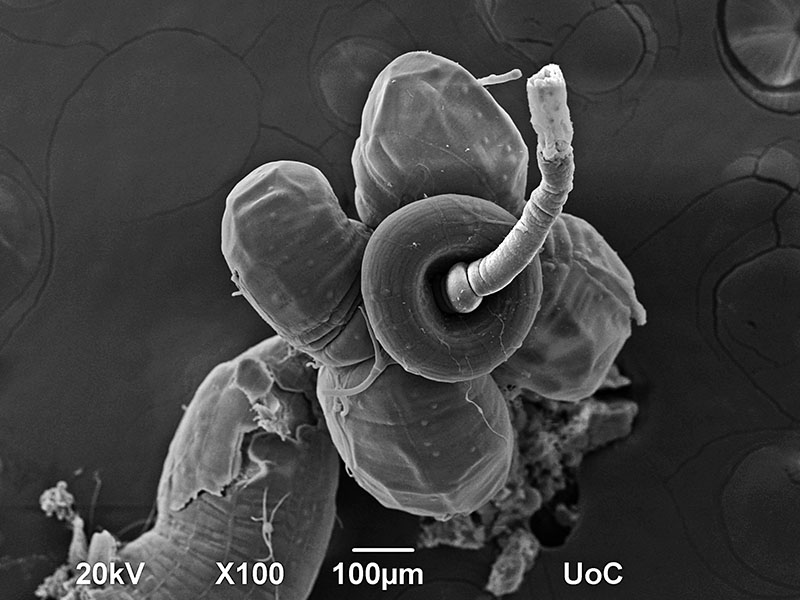 |
| Gastric caeca and proventriculus of the olive fly |
A collaborative project with the laboratory of John Vontas aims to shed light on the interaction of the olive fruit fly with its bacterial symbiont Candidatus Erwinia dacicola. We have focused on two stages of the fly, the larva and the adult, where the bacterium is known to provide crucial factors. In the larva we analyzed the gastric caeca, the organ where the bacterium mainly resides in this stage. We verified that the bacterium is localized inside a peritrophic membrane in the lumen of the caeca and refuted the previous notion that the bacteria are intracellular in this stage. Furthermore, a transcriptomic analysis of the fly organs comparing a laboratory population devoid of the bacterium with wild flies harboring the symbiont revealed differences in expression of genes involved in immunity.
In the adult fly the bacteria reside in the so-called esophageal bulb, a blind organ of the esophagus, the midgut and in the female the ovipositor. Microscopy revealed the structure of the esophageal bulb and the ovipositor and showed that the bacterium is found in the lumens of the bulb and the diverticula of the ovipositor. Proteomic and transcriptomic analysis of the three organs further concluded that the bulb is mainly involved in transport, while the diverticula appear to be metabolically silent. The analysis of the bacterium showed that their metabolic profile in each of the three organs is considerably different. Importantly, DNA replication was restricted to the esophageal bulb. In this organ enzymes involved in nitrogen uptake were overrepresented comparing to the other organs, supporting the notion suggested previously that the bacterium complements the nitrogen-poor diet of the fly.
These studies lay the ground work for further understanding of the role of the symbiont in the fly’s life cycle and may suggest opportunities for novel strategies to combat this important pest.
References:
Livadaras et al. (2021) Stably inherited transfer of the bacterial symbiont Candidatus Erwinia dacicola from wild olive fruit flies Bactrocera oleae to a laboratory strain. Bull Entomol Res. 2021 Jun;111(3):379-384. doi: 10.1017/S0007485321000031.
Siden-Kiamos et al. (2022). Dynamic interactions between the symbiont Candidatus Erwinia dacicola and its olive fruit fly host Bactrocera oleae. Insect Biochem Mol Biol. 2022 Jul;146:103793. doi: 10.1016/j.ibmb.2022.103793.
Siden-Kiamos et al. (2025) The Journey of the Bacterial Symbiont Through the Olive Fruit Fly: Lessons Learned and Open Questions. Insects 2025, 16, 789. doi.org/10.3390/insects16080789. Review.